recording campMulti-day writing camps and album sessions — whole-facility rental with accommodation
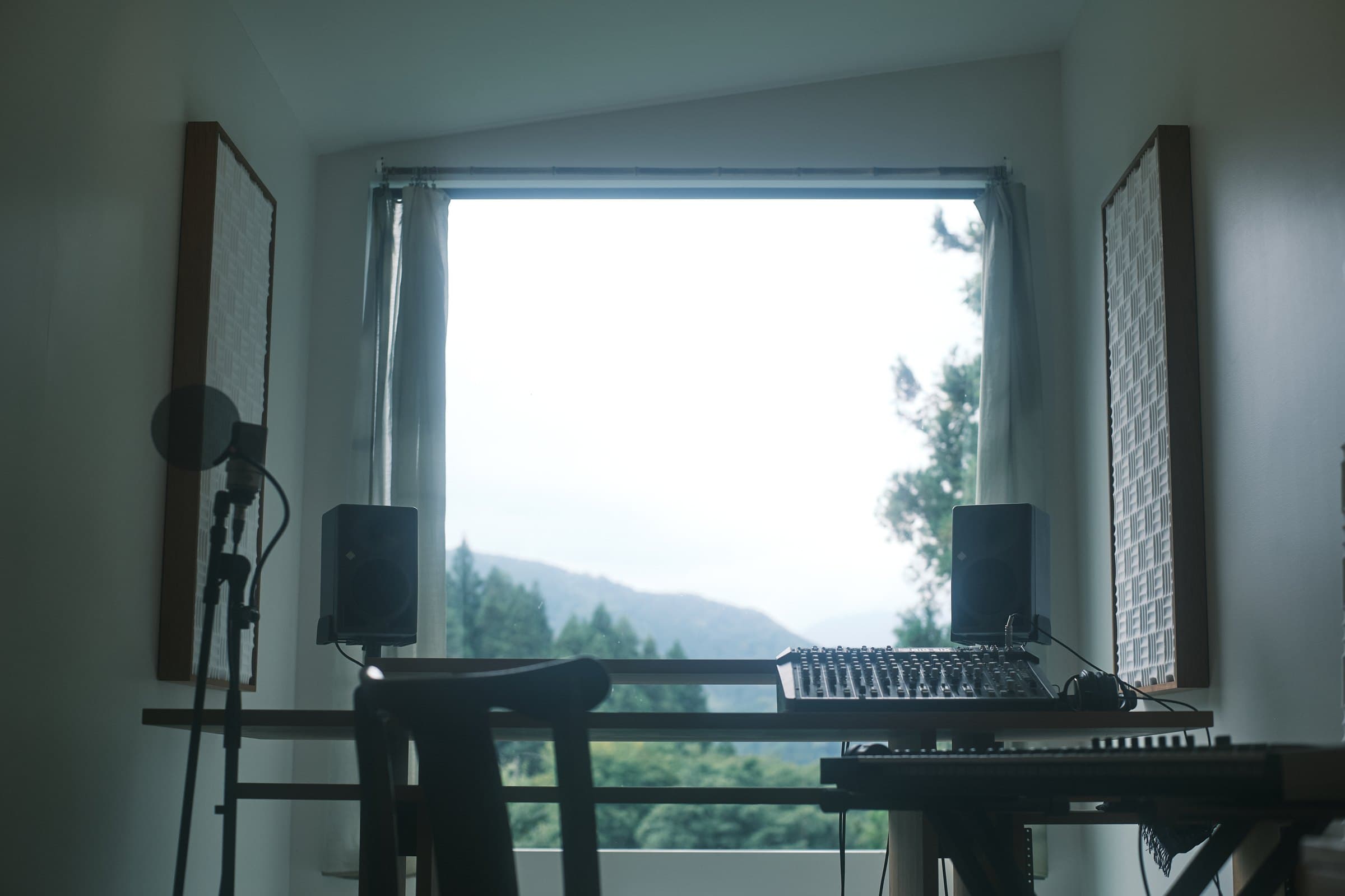
A recording studio with overnight accommodation in Fujino, Kanagawa. Rent the whole property and use it for recording, music camps, creative retreats, shoots, and workcations. About an hour by car from central Tokyo. SSL Big Six and Neumann monitors and microphones on site — stay over and keep working.
Artists stay, record, and create here. We build spaces where independent creators can stay true to their vision.
The whole place is yours
The studio and the accommodation are separate buildings, and during your stay the entire property is reserved for your group. No shared rooms, no shared schedule.
- Studio building — control room with a large window facing the mountains. SSL Big Six, Neumann monitors and mics on site
- Accommodation building — sofa bed and loft, shower and toilet, kitchenette (kettle, coffee gear, fridge), lounge, deck
- Sleeps 3–4. Larger groups combine the studio with a place to stay nearby
- Parking for three vans, so you can drive your own gear in
Gear on site
- Monitors — NEUMANN KH 750 DSP D Gen.2 / KH 120 II
- Microphones — NEUMANN TLM 103
- I/O — Solid State Logic Big Six
- Compressors — AVALON DESIGN VT-747SP
- Instruments — KOMPLETE KONTROL A61 MIDI keyboard
There is more on site. Get in touch about the full list, or about bringing your own rig in.
Rates
- Day use — $300
- 2 days / 1 night — $500
- Each additional night — +$200
Per facility, not per person. These are independent-artist rates; labels, companies, and commercial shoots are priced separately — please get in touch.
Studio location
〒252-0186 神奈川県相模原市緑区牧野3771-7
3771-7 Makino, Midori Ward, Sagamihara, Kanagawa 252-0186, Japan
Good for
- Album and EP sessions
- Songwriting camps and co-writing trips
- Band pre-production and arrangement work
- Beat-making and track-building stretches
- Finishing a mix without interruption
- Label or team offsites
About Fujino
Fujino (population around 8,000) is one of the closest satoyama areas to central Tokyo. Artists were evacuated here during the Second World War, and since the 1990s the area has hosted art projects and residencies. Many makers still live and work here, and it is one of Japan’s Transition Movement towns.
Dozens of small villages sit in valleys overlooked by the Tanzawa Mountains, surrounded by forest and streams. Having nothing but mountains outside the window is part of how a camp works.
The area
A map of places worth stopping at during your stay — shops, food, hot springs, and a few things nearby.
FAQ
How many people can stay?
The accommodation building is simple — a sofa bed and a loft — and it sleeps three to four. For bigger groups the arrangement is the studio to yourselves by day and a house nearby at night; see “Where bigger groups sleep” on this page.
Can a larger group do a camp here?
Yes. Tell us how many people will be in the studio during the day. For sleeping, Fujino has whole-house farmhouses and cottages, some taking fifteen or twenty-five people. This page lists places in Makino, the studio’s own valley (Hourokusha, Shinkirou), and in Hizure near Fujino station (Ooda Sanso, Nissoen).
How is this different from renting a cottage or a holiday house?
You get the whole place to yourselves either way. The difference is that inou is a recording studio first: a control room facing the mountains with SSL Big Six and Neumann monitors and mics installed, and the accommodation building next to it. It was built for making records, so you can work loud until late, sleep on site, and carry on the next morning.
Can we stay several nights?
Yes. A 2 day / 1 night stay is $500, and each additional night is $200 — so four days and three nights comes to $900 in total.
Can we bring our own gear?
There is parking for three vans, so you can drive gear in and load directly. Tell us in advance what you plan to bring and what power you need.
What about food?
The accommodation building has a kitchenette with a kettle, coffee gear, and a fridge. For shops and places nearby, see the area map on this page.
How far is it from Tokyo?
About an hour by car from central Tokyo, and roughly 1.5 hours from Haneda Airport. By train, Fujino station on the JR Chuo line is about an hour from Shinjuku, and you need a car from the station to the studio.
Can we use it for something other than recording?
Yes — shoots, workcations, and retreats all work here. Shoots and commercial bookings are priced separately, so please get in touch.
Where bigger groups sleep
The accommodation building is simple — a sofa bed and a loft — and it sleeps three to four. When the group is bigger than that, the arrangement we suggest is the whole studio to yourselves by day, and a house nearby at night.
Fujino is full of whole-house rentals: old farmhouses and cottages, some of them taking fifteen or twenty-five people. Hourokusha and Shinkirou are in Makino, the same valley as the studio. Ooda Sanso and Nissoen are in Hizure, closer to Fujino station.
Larger groups (10+)
- Ooda Sanso(おおだ山荘)Whole-house farmhouse rental. Sleeps 25 in the main house, 7 in the annex (Hizure)Website (JP)
- Yuzu no Ie(柚子の家)A 150-year-old farmhouse, renovated. Sleeps 16+, with a 48㎡ room that works for meetings and workshopsAirbnb
- Hourokusha(峰麓舎)Whole-house farmhouse rental. Sleeps 15 across three tatami rooms, fire pit, parking for five. Same Makino district as the studioAirbnb
- Nissoen(日相園)Nine cottages by Lake Sagami. 2–15 people, BBQ facilities (Hizure)Website (JP)
Smaller groups (4–8)
- Shinkirou(神氣龍)Whole-house rental, sleeps 8. Pickup from Fujino station on request. Same Makino district as the studioWebsite (JP)Airbnb
- Fujino House(藤野ハウス)Whole-house rental, sleeps 6. A 12-minute walk from Fujino station, with a supermarket and convenience store three minutes awayAirbnb
- Gallery RoomA separate private room, sleeps 4. Hung with paintings, hot springs nearbyAirbnb
Check rates, availability, and pickup directly with each place — we do not book on your behalf, but we are happy to talk through how to split a group across dates and houses.
Our booking calendar is public.